Themes, Not Moves: Paul Carpenter on the Opposite-Coloured Bishops
One of the club’s strongest players takes us through a piece sacrifice — and the single idea that justifies it.
The club was treated to a lecture from one of its top players, Paul Carpenter, who took us through one of his own games and the position shown below.
Paul began by drawing our attention to a theme rather than a move. With opposite-coloured bishops on the board — the defender’s bishop can never defend the squares the attacker’s bishop controls, leaving the defender with weaknesses that simply cannot be covered.
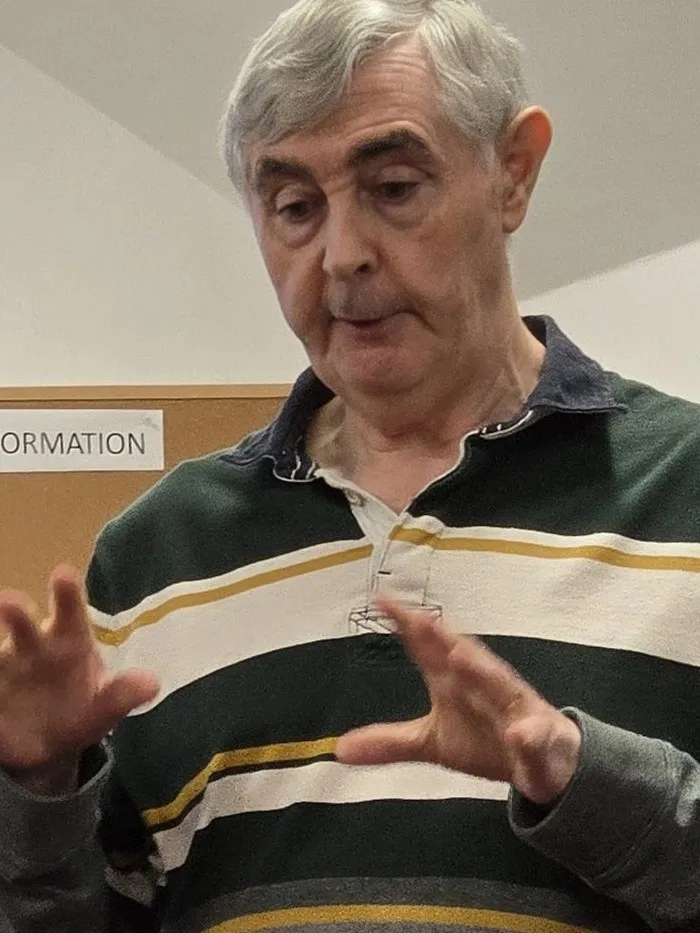
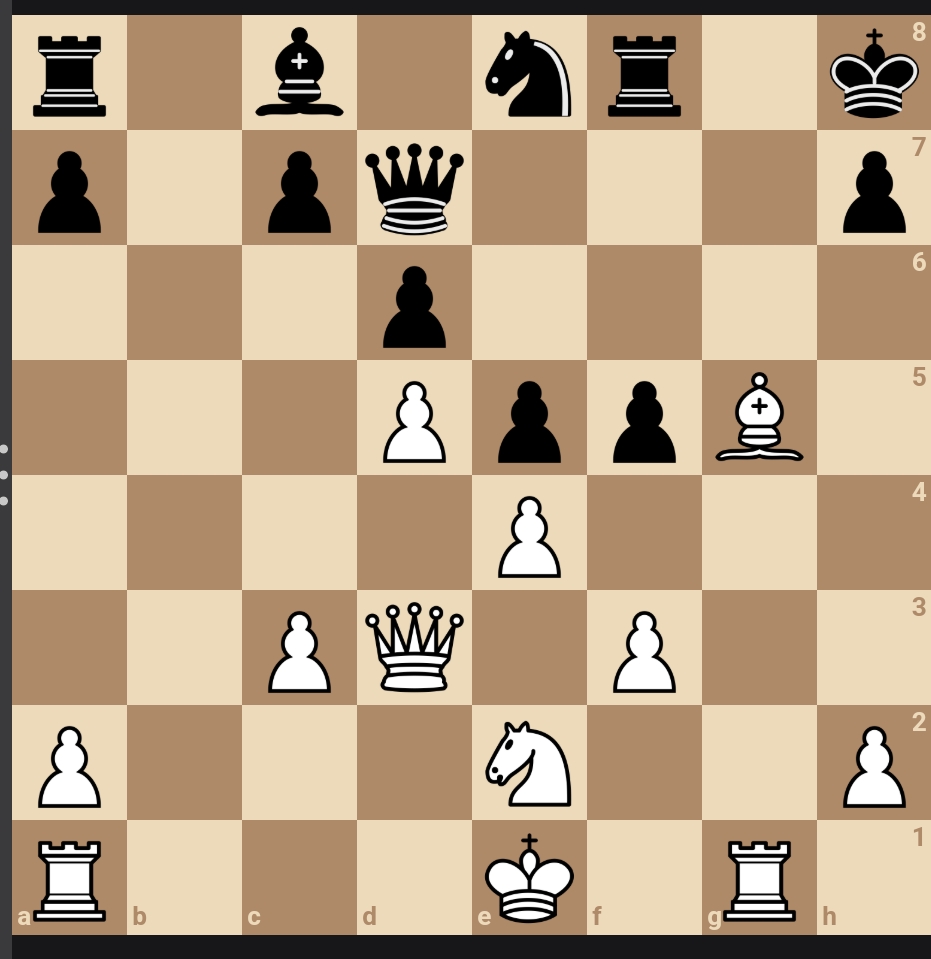
He illustrated this with a game of his. In this position Paul was white, material and the position was even. The move that follows from that idea is a sacrifice. Paul played his knight to d4, offering it up. Black accepted with the e5 pawn — a knight traded for a pawn — and two points down on material, White had total control of the dark squares and an attack that never let up.
White’s bishop on g5 and Black’s bishop shut in on c8 — he explained that when you are the one attacking, the advantage is equivalent to being a piece up. The reason is simple: Black’s bishop can never defend the squares White’s bishop attacks. The dark-square complex around the black king — g7, h6, f6, e7 — belongs to White, and Black has no way to contest it.
After 1. Nd4 exd4 2. Qxd4+ Qg7 3. Be3 Qf6 4. Qd2 Qh4+ 5. Bf2 Qe7 6. O-O-O, white had a winning position. Paul also discussed the moment the game turned. Black could have swapped queens with 3. …. Qxd4, which would have blunted the attack and held the position. Instead he decided to keep the queens on with 3. …. Qf6, and the dark-square grip tightened. Still two points down on material, White was completely winning after this move.
He then showed a second game in which the same theme — opposite-coloured bishops in the attack — proved decisive.
The general point Paul left us with was perhaps the most valuable of the evening: strong players look for themes and strategic positions rather than specific moves. Material is a means, not an end — and knowing which squares matter tells you which moves to look for.
The lecture was warmly received and gave us plenty to think about. Our thanks to Paul for a thoroughly enjoyable and thought-provoking evening.
About The Author
